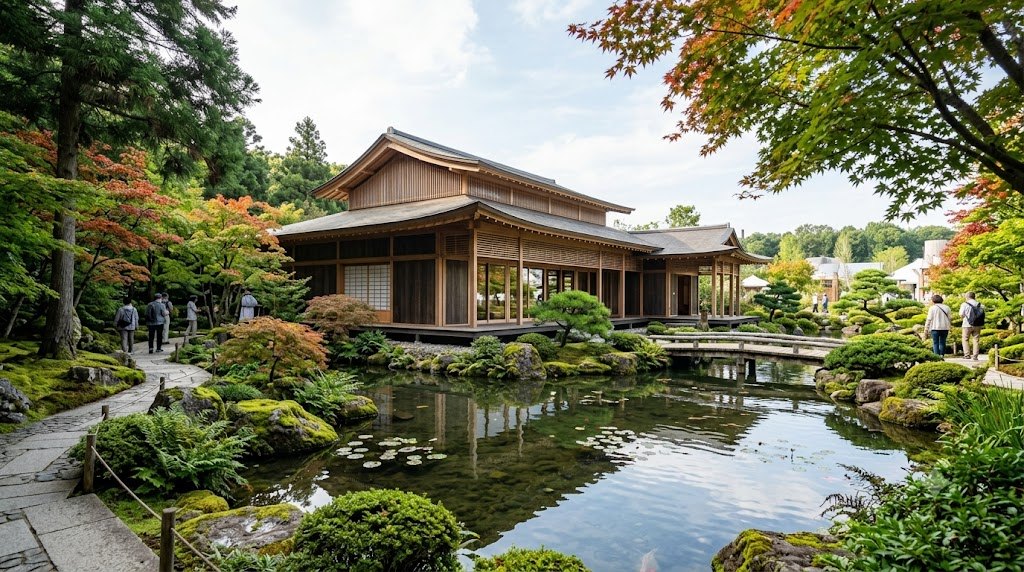
 Japan Pavilion and Garden
Photo: Japan Pavilion and Garden, exterior (rendering) / 日本政府(国土交通省・農林水産省) (公式サイトからの引用) via GREEN×EXPO 2027公式サイト
Japan Pavilion and Garden
Government of Japan (MLIT and MAFF)
- Theme
- Reconsidering the Japanese View of Nature, Moving Toward the Future
- Highlights
- About 2.5 ha, the largest exhibit at the venue, with the garden and pavilions planned as one space (teioku ichinyo) at the headwaters of the Izumi River
- Ikebana by heads of major schools, shown in six arrangement styles, one style per exhibition period (planned)
- Bonsai long kept by the Imperial Household Agency, rotated twice during the Expo; two of them have never been shown outside the Imperial Palace
- An immersive theater on Japan's natural environments, plus technologies for environmental challenges shown with actual equipment and outdoor exhibits
- Elevated wooden pavilions split into east and west buildings, with earthen walls and an event space hosting rotating ministry events
Official site & social media
- Page on the GREEN×EXPO 2027 official site
- expo2027yokohama.or.jp/en/learn-enjoy/japan-gov-garden
- Exhibitor's official page
- expo2027-japan.go.jp/en
User-submitted estimate (unofficial). Today's crowd guide
The Japan Pavilion and Garden (Nihon Seifu-en) is the Government of Japan’s exhibit at GREEN×EXPO 2027, presented jointly by the Ministry of Land, Infrastructure, Transport and Tourism (MLIT) and the Ministry of Agriculture, Forestry and Fisheries (MAFF). At about 2.5 hectares it is the largest exhibit on the grounds. Its concept is “Reconsidering the Japanese View of Nature, Moving Toward the Future,” and its exhibition theme is “The Japanese View of Nature.”
Exhibits
According to the exhibition overview released on May 22, 2026, the pavilions will feature:
- An immersive theater presenting the natural environments of regions across Japan.
- Everyday wisdom and techniques that people have developed through their relationship with nature.
- Ikebana by heads and leading members of schools in the Japan Ikebana Art Association, shown in six styles (Rikka, Nageire/Heika, Seika/Shoka, Bunjinbana, Moribana and Jiyubana), one style per period. Planned cooperating schools include Sogetsu, Ikenobo, Ryusei-ha and Ohara.
- Bonsai managed for many years by the Imperial Household Agency at the Omichi Garden of the Imperial Palace, rotated twice during the Expo. Three trees have been announced: the Japanese black pine “Kashima” (390 years old, also shown at Expo ‘70 in Osaka), a Japanese cypress (340 years) and the Japanese white pine “Neagari” (390 years). The last two will be shown outside the Imperial Palace for the first time.
- Environmental challenges and solutions, with Japanese technologies and initiatives introduced through actual equipment and outdoor exhibits.
At the Expo’s half-year-to-go press event on September 15, 2026, the Minister of Agriculture said the garden will also present traditional food culture and advanced technologies such as plant factories and land-based aquaculture.
The garden includes an event space (about 80 m²) and a hands-on deck (about 40 m²) where ministries will hold rotating events. The first event list (September 15) includes MAFF’s “Japanese flower culture and industry” (March 20–25, 2027), MLIT’s “Green Infrastructure Exploration Center” (April 3–7) and a flower contest (June 10–15 and September 17–22). All dates are provisional.
Five high school teams selected through MAFF’s high school garden project (from Hokkaido, Chiba, Kanagawa, Mie and Kyoto) will create gardens in the government exhibit area on the theme of scenery made with flowers and greenery.
Garden and architecture
The garden and pavilions are designed as one integrated space based on teioku ichinyo, the idea that garden and building form a single whole. The “Reiwa Japanese Garden” draws on traditional Japanese garden techniques while incorporating basin-wide flood control and green infrastructure from the perspectives of water, carbon and nitrogen cycles. Chief Director Minomo Toshitaro describes a sequence from gardens close to people to groves and woodland. The pavilions are elevated wooden structures split into east and west buildings to reduce impact on the river’s headwaters, with earthen walls and materials chosen for reuse after the Expo.
Timeline
- August 2023: MAFF and MLIT adopt the basic plan for the government exhibit
- November 2, 2025: Groundbreaking ceremony at the site
- March 19, 2026: Official website and symbol mark launched
- May 22, 2026: Exhibition overview (theater, ikebana, Imperial bonsai) released
- July 14, 2026: Recruitment of guide crew opens
- September 15, 2026: Ministry events in the garden’s event space listed in the Expo’s first event list
- September 30, 2026: Interview with Chief Director Minomo published on the official site
- October 24, 2026 (planned): Talk in Kyoto on the “Reiwa Japanese Garden” with director Inoue Toshihiro (hosted by MLIT)
Before you go
The Japan Pavilion and Garden is in the southern part of the venue along the Izumi River, south of the Horticultural Pavilion “IROHA-GARDEN.” The Expo will introduce same-day viewing reservations for some exhibits, but which facilities are covered had not been announced as of October 2026. Accessibility details specific to the garden have not been announced.
Sources: Japan Pavilion and Garden official site (checked 2026-10-04) / Exhibition overview, May 22, 2026 (checked 2026-10-04) / Directors Column, Sep 30, 2026 (checked 2026-10-04) / GREEN×EXPO 2027 event information (checked 2026-10-04) / Event list press release, Sep 15, 2026 (PDF) (checked 2026-10-04) / Half-year press event release (PDF) (checked 2026-10-04) / MAFF high school garden project (checked 2026-10-04) / MAFF groundbreaking release (checked 2026-10-04) / MLIT Japan Pavilion and Garden page (checked 2026-10-04) / Kyoto talk announcement, PR TIMES (checked 2026-10-04)
Note: exhibits and highlights will be updated as official announcements are made.
Comments on this pavilion
- Loading…
- Always verify on the official site — this is an unofficial, user-generated board.
- Not allowed: misinformation / harassment / discrimination / personal data / ads / links / anything unlawful or offensive.
- Opinions and questions appear instantly. Posts with factual claims (prices, dates, cancellations) are held until checked, then published if fine.
- Please “Report” inappropriate posts. Enough reports auto-hide a post.
- Posts are user-generated and not verified by this site. Check prices and dates on the official site before you act.