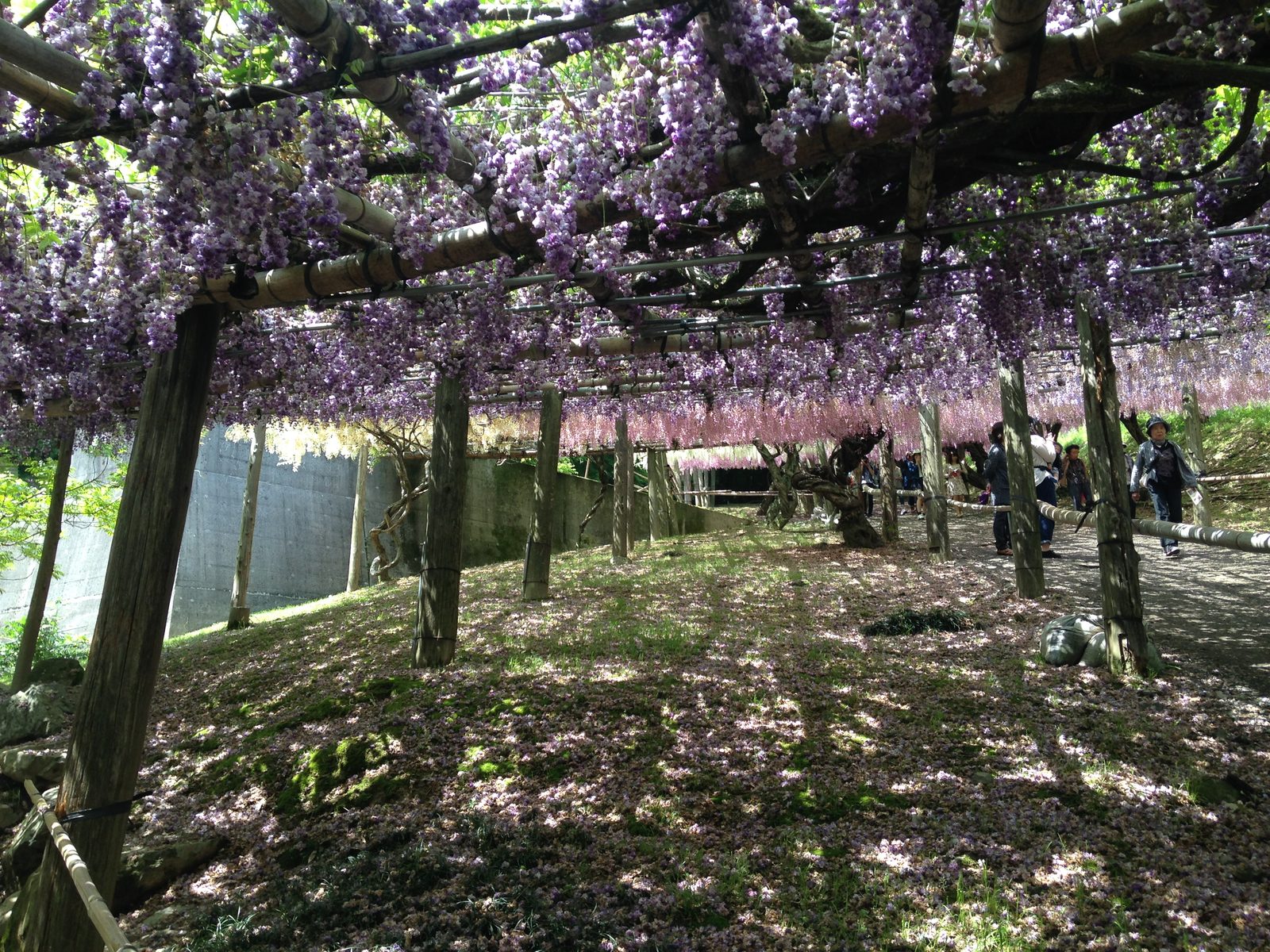
Photo: Wisteria / そらみみ (Soramimi) (CC BY-SA 4.0) via Wikimedia Commons
GREEN×EXPO 2027 Highlights: Pavilions & Villages to Watch
The grounds cover about 100 hectares, and the expo runs for 192 days. GREEN×EXPO 2027 (the 2027 International Horticultural Exposition) is built around flowers and greenery — it is not the kind of event with roller coasters and thrill rides.
That is exactly why deciding in advance which halls to see, and with what interest, makes such a difference. This article walks through the pavilions confirmed so far and how to enjoy the five villages, sticking to what we can actually verify.
A quick note: this site is an unofficial guide. Always confirm the latest details on the official website. We also keep a running list on the pavilion guide page.
Key highlights at a glance
- Japan Pavilion and Garden — the largest exhibit at ~2.5 hectares, featuring an immersive theater on “The Japanese View of Nature”
- Theme Pavilion “NEKKO” & Horticultural Pavilion “IROHA-GARDEN” — core facilities run by the Expo Association itself: one on how plants connect all life, the other on Japan’s horticultural culture handed down since the Edo period
- 390 exhibition gardens — every prefecture and every ordinance-designated city participates, from Okinawa Churaumi Aquarium’s floral whale shark to Ibaraki’s Kairakuen
- Five villages — Technology (Urban GX), Crafts (Craft), Food (Farm & Food), Children (Kids), and Countryside (SATOYAMA) offer something for every interest
- Seasonal flowers — across the 192-day event, different flowers bloom from spring tulips to autumn cosmos
Read on for a closer look at each area.
Start with the must-see halls (Japan Pavilion and Garden, Theme Pavilion)
If you’re not sure where to begin, these two are a safe bet.
Japan Pavilion and Garden
At roughly 2.5 hectares of exhibition space, the Japan Pavilion and Garden is among the largest on the grounds, and its concept is “Reconsidering the Japanese View of Nature, Moving Toward the Future.”
It is set to feature an immersive theater presenting the natural environments of regions across Japan, offering a chance to feel — rather than just read about — how people in Japan have related to nature for centuries.
Because it’s large and likely to be popular, visiting in the morning right after the gates open will make the rest of your day easier. See the Japan Pavilion and Garden page for more.
Theme Pavilion and Horticultural Pavilion
The Theme Pavilion “NEKKO” is the conceptual backbone of the whole expo. Under the concept “All life is connected, with plants at the heart,” it uses art and hands-on experiences to show the hidden abilities of plants and their ties with other life, encouraging action based on Nature-based Solutions (NbS).
That may sound abstract, but the core idea is simple: borrow nature’s own power to solve society’s problems. Seeing this first gives you a clear lens for everything else — the corporate halls and the villages alike.
The Horticultural Pavilion “IROHA-GARDEN” is another of the major facilities, and a good fit if you want to dive deeper into horticulture itself.
Build your day around two or three of these anchor halls, and even a 100-hectare site starts to feel manageable.
Standout halls in Urban GX Village (Obayashi, Mitsubishi, Kajima, Daiwa House and more)
If technology and city-building appeal to you, Urban GX Village is the place to head. Themed around “cutting-edge technology for a green society,” it brings together some of Japan’s best-known companies. The exhibitors confirmed so far are:
- OBAYASHI MORI SORA MIRAI (Obayashi) — hands-on future craftsmanship set in “Mori no Kuni” (the Country of the Forest), in harmony with nature, and “Sora no Kuni” (the Country of the Universe), where life with space is part of everyday life
- Mitsubishi Minnano Miraikan (Mitsubishi group) — a ride-based exhibit traveling through the sea, land and sky, themed “Everyone Together, for a Planet of Abundance”
- KAJIMA TREE (Kajima) — a timber tower about 60m tall whose columns and beams reuse wood from the Grand Ring of Expo 2025 Osaka, Kansai
- Daiwa House Group Endless Heart Park — an outdoor exhibit of 35 water-topped glass parasols, themed “Future Living Created by Wind, Sun, Water and Greenery”
- Yasashiku Naritai STUDIO (Toho-Leo) — a hall reusing the facade of Panasonic’s “The Land of NOMO” pavilion from Expo 2025 Osaka, Kansai
- NTT EAST Pavilion “well” (NTT East) — multisensory experiences of a well-being society where industry, nature and culture are in harmony, using IOWN and other cutting-edge technology
- KT GROUP Mobi+ (Mobitas) — the KT Group’s hall on future daily life that adds the mobility of cars to a resource cycle starting with household vegetable and fruit scraps
- Tokyu Group Pavilion — a building shaped like seeds nestled together, themed “GREEN LIFESTYLE 2050”
- CIRCULAR LINK YOKOHAMA Hub (Tsunagu Yokohama-kan, City of Yokohama) — Yokohama City’s indoor pavilion, with a Lifestyle zone for greener everyday choices and a Future zone of advanced technologies from sponsoring companies
Toho-Leo’s reuse of building materials from Expo 2025 Osaka is a nice example of the circular-economy spirit at the heart of this expo. A practical plan is to take in the technology halls together in the morning, then move on to the other villages in the afternoon.
Note that some halls, such as the Tokyu Group Pavilion, have yet to announce the specific contents of their exhibits (as of October 2026). We’ll update this site as more information is released.
Standout halls in Farm & Food Village (JA, Meiji, Yamazaki Baking, Sakata Seed)
If you’re drawn to food and wellbeing, head to Farm & Food Village. Themed around agriculture, food and healthy living, it’s a smart area to tour around lunchtime. The confirmed exhibitors are:
- JA Group “ITADAKIMASU: Bringing the Bounties of Nature to the Table” — the JA Group’s themed commercial outlet, pairing an indoor exhibition on Japanese food and farming with a market of seasonal produce from across Japan and a fresh juice stand
- Meiji Group “ORAGA VILLAGE — Hometown of the Future” — an outlet themed “Regeneration,” modeled on the satoyama village where Karl Ojisan of Meiji’s Karl snacks lives
- Yamazaki “A Bright Table for Tomorrow” Pavilion — Japan’s bread culture told through projection mapping and an immersive theater, with a Daily Yamazaki store next door
- Sakata Seed “Seed Journey” — a special exhibition hall that the major seed company Sakata Seed sets up as part of its Flower & Greenery Exhibition
- HONEY HARMONY GARDEN (Marucho) — Marucho Corporation’s themed commercial outlet, built around the links between honeybees, flowers and microbes (fermentation)
The one with a perspective only a seed company could offer is Sakata Seed’s “Seed Journey” hall. Real seeds on display, a roughly three-minute film about the future that grows from a single seed, and hands-on looks at how a seed company gets seeds out to the world resonate naturally with the theme of a flower-and-greenery expo. See the Sakata Seed page for details.
Because this is where the food-related halls cluster, you can tour them while keeping yourself fed — a practical perk of this village.
The five villages at a glance and how to enjoy them
The grounds are organized into five “villages.” Knowing the character of each makes it easier to pick the areas that match your interests.
| Village | Theme | Best for |
|---|---|---|
| Urban GX Village | Cutting-edge technology for a green society | Fans of technology, architecture and city-building |
| Craft Village | Traditional crafts living in harmony with nature | Anyone drawn to crafts and making things |
| Farm & Food Village | Agriculture, food and wellbeing | Those interested in food and healthy living |
| Kids Village | Hands-on nature education for the next generation | Families with children |
| SATOYAMA Village | The comfort of people and nature coexisting | Lovers of countryside scenery and nature walks |
Confirmed exhibitors in each village
The official village exhibitor list includes the following.
- Craft Village — Takenaka Group Kurukuruku, Sumitomo Forestry’s “Hyaku no Mori” (100 Forests)
- Kids Village — SOTETSU PARK (Sotetsu Group), Shimizu Mori no Machi (Shimizu Corporation, built with timber reused from the Expo 2025 Osaka Grand Ring)
- SATOYAMA Village — UR GREEN TABLE (Urban Renaissance Agency), Tsunagu Yokohama Field (City of Yokohama)
Exhibit details are still being announced hall by hall, but you can sketch out the big picture now — families might center their day on Kids Village, while anyone who’d rather stroll through nature could build around SATOYAMA Village.
How to plan your route
The trick to enjoying it all is to favor the villages you care about rather than spreading yourself thin across all five. Lean into Urban GX if you love technology, or make Farm & Food your base if food is the draw — that turns your route into a single connected line and saves your legs.
Choosing your day of the week helps too. In the official daily visitor estimates, weekdays (outside Golden Week and the summer holidays) draw about 50,000 people a day, versus roughly 105,000 on peak-period weekends and holidays — more than double.
If you can aim for a Tuesday, Wednesday or Thursday, the grounds will simply feel easier to walk.
For detailed timing and itineraries by who you’re with, see our model courses article.
Seasonal flowers are a highlight in their own right
As a general guide for Yokohama and the wider Kanto region:
| Flower | Typical bloom window |
|---|---|
| Tulips | Late March to April |
| Nemophila | April |
| Wisteria | Late April to early May |
| Roses | Mid-May to June |
| Hydrangeas | June |
| Sunflowers | Late July to August |
| Dahlias | Late August to September |
| Cosmos | September |
The specific plantings on the grounds await official announcement, but making the flowers in season one of your goals adds a pleasure quite different from hall-hopping. See our bloom calendar for more.
Opening day spotlight: Blue Impulse aerial display (March 19, 2027)
The Japan Air Self-Defense Force’s aerobatic display team Blue Impulse is scheduled to fly over the GREEN×EXPO 2027 venue on opening day, March 19, 2027. The flight was listed in the JASDF’s 2026 fiscal-year display-flight schedule, announced by the Minister of Defense at a post-cabinet press conference on March 3, 2026 (DC Watch, May 25, 2026). Specific times and flight routes have not yet been announced, and the display will be cancelled (not rescheduled) in the event of bad weather. If you plan to visit on opening day, it may be worth leaving a gap in your schedule to look skyward.
More highlights to come with future announcements (national pavilions and more)
Everything above is what we can confirm at this point. As of the Association’s list dated August 4, 2026, 71 countries and 5 international organizations have declared their participation in GREEN×EXPO 2027. Their exhibits take the form of gardens, and apart from the United Kingdom and Italy the contents have not yet been released (see the list of participating countries (in Japanese)). The list of highlights will keep growing as they are announced.
Likewise, details for corporate halls whose exhibits are still under wraps — the Tokyu Group Pavilion, for example — are expected to be announced in stages.
Where information isn’t confirmed — such as the involvement of particular architects — this site won’t state it as fact, and we’ll update as announcements are made.
For reference, although the scale, venue and theme are different, Expo 2025 Osaka, Kansai saw information about participating countries’ pavilions come together gradually as the opening approached.
Yokohama will likely follow a similar path, with the full picture emerging little by little ahead of opening day. The right stance is to anchor your plan with the confirmed must-see halls for now, while looking forward to each new announcement.
Once you have a sense of the highlights, the next step is the practical planning. See the pavilion guide for the full list of halls, the model courses for itineraries by time and company, and What is GREEN×EXPO 2027? for an overview of the expo itself.